What follows is a project done for my ENG 617 "Postcolonial Lit" Class for my MAT at Western. This idea had been percolating the whole course, and while it wasn't exactly "the assignment" as written, I give a lot of thanks to my prof Dr. Laura Wright for giving me the green light. Please enjoy and give me your feedback! I want criticism!!
A note on format: italics denote a picture caption, and "-------------" implies separation between vignettes.
Adventures in Postcolonial Photojournalism: The Spiti Situation A group of villagers eats lunch together outside of Demul, Spiti Valley, 2008.
 Postcolonialism was introduced to me as a literary genre. Certain books, I learned, could qualify for this specialization if they were written from a country that had been formerly colonized. Laura Moss’s outlining of postcolonial issues is suitably broad for a somewhat amorphous subject like this: “cultural imperialism; emergent nationalisms within a nation and between nations; negotiating history and the process of decolonization; hierarchies of power, violence, and oppression; censorship; race and ethnicity; multiculturalism; appropriation of voice; revising the canon and ‘writing back’ to colonial education; and Indigenous languages and ‘englishes’ versus Standard English” (4). Moss uses her definition to qualify Canadian literature as, at times, postcolonial, and now I would like to use her definition to once more stretch the limits of the postcolonial genre to include some of my own writing and photography about something I call “The Spiti Situation”.
This is a complicated, layered project. At the heart, though, is beautiful Spiti Valley, my home of five weeks in the spring and summer of 2008. I believe Spiti is a site of ongoing postcolonial negotiation, not for India’s grappling with British Imperialism, but for Spiti’s destructive encounter with Modernity. Second is consideration of my own role as a traveler and photographer in Spiti— is it possible for someone like me to do good for an indigenous population? Also I try to probe the thorny issues surrounding representation, issues inherent to photography, photographs, and photographers. Unfortunately, I will not be able to deal with each layer as neatly as I’ve laid them here; I’m afraid they mix and mingle and occasionally talk out of turn. What’s worse, instead of resolving my queries into these issues, often the questions are ultimately left unanswered: you will have to draw your own conclusions. And remember, this text is only an introduction; the true exploration of these matters lies in interpretation of the images and prose after it.
 A professional Indian photographer snaps photos of Lama’s at Thikse Monastery, Ladakh, 2008. The high Tibetan Plateau and its unique Buddhist culture are exotic to the Indian mainland and international travelers alike.
The changes in Spiti closely parallel the recent history of its cultural and regional neighbor, Ladakh. Ladakh has been open to tourism for almost 40 years, about 25 years longer than Spiti. Leh, the capital, with its airport and many comfortable hotels, remains the more popular destination to Spiti. Helena Norburg-Hodge traveled to Ladakh before the area was opened to tourism as a linguist, learned the local dialect fluently, and lived closely with local people for several years (91-92). Later, when the area opened to tourism, she noted many changes and wrote the book, Ancient Futures: Learning from Ladakh, as a collection of observations about the sustainable way of life she witnessed in Ladakh, as an indictment of Western culture, and as lamentation over the destructive changes that happened there with the arrival of modernity. She writes about modernization as a colonizing force, saying, “Today’s conquistadors are ‘development,’ advertising, the media, and tourism” (3). While her summary of the Ladakh situation, which is almost completely analogous to the Spiti situation I’m writing about, is largely one-sided and oversimplified, her observations remain critical to understanding what’s happening all over the Tibetan Plateau beyond the Rhotang Pass.
A great many pages of her book deal with the regional ecological destruction that is readily apparent at any glance, a devastation that is not to be minimized in the least; however she astutely identifies a parallel cultural loss that is not so apparent. She explains, “the psychological impact of modernization has been felt throughout the entire region… In one day a tourist would spend the same amount that a Ladakhi family might in a year… Compared to these strangers, they suddenly felt poor” (95), and “The sudden influx of Western influence has caused some Ladakhis— the young men in particular— to develop feelings of inferiority. They reject their own culture wholesale, and at the same time eagerly embrace the new one. They rush after the symbols of modernity…”(98). To write such a process off as “natural” or “inevitable” would demand the incorrect assumption of cultural superiority, a mindset that is inherent to the spread of Modernity and other forces of colonization. Ladakh, and Spiti, while not quite the mostly utopian society described in Ancient Futures, had and still has much to offer to the future “progress” of the world.
In a seminal tract of postcolonial theory, Edward Said argues that the Occident’s relationship with the Orient was (and still often is) a “systematic discipline by which European culture was able to manage— and even produce— the Orient politically, sociologically, militarily, ideologically, scientifically, and imaginatively…” (3), and, in short, describes “Orientalism” as “a Western style for dominating, restructuring, and having authority over the Orient” (3). The implication for such an argument if accepted, as we should, as sound, is that we shouldn’t do that any more. Said, by spelling out what was going on within the discourse of information about Eastern places, hoped to open the terrain of knowledge to new ways thinking about Eastern topics.
The notion of Orientalism applies directly to this project in a couple ways. First and foremost, it demands the reader be critical of my role as a Western traveler in the East. Being a Westerner, and especially today as an American, carries, whether we accept them or not, definite bearing upon the relationships I had with the local people. Sadly and discouragingly, I am drawn to the conclusion that by mere virtue of being there, and in spite of all my good efforts and best intentions, I acted as an agent perpetuating the Oriental discourse. The tourist, and even the most unassuming traveler, goes to India because he can, “which puts the Westerner in a whole series of possible relationships with the Orient without ever losing him the relative upper hand... The scientist, the scholar, the missionary, the trader, or the soldier was in, or thought about, the Orient because he could be there…” (Said, 7). I saw this relationship play out time and time again while I was in India, and specifically while I was in Spiti, and it deeply troubled me. Even engagement in philanthropic work with the Spiti EcoSphere NGO, where I worked partially in an attempt to offset my “traveler’s guilt”, seemed to perpetuate the dominance of my own nationality and its Modernity. For my part, I was a persistently respectful traveler; I worked for locals, and I learned from locals— I met many who were not respectful— and yet because I paid to come there, because I looked through a camera lens, there was nothing I could do to escape my, as Said called it, “positional superiority” (7).
On the other hand, how Orientalism applies to photography is not nearly so clearly damning; it may, in fact, provide sound reasoning in favor of it. But first, the obvious fact is that before photography ever did anything against Orientalism, it was most certainly its purveyor. Said asks, “What other sorts of intellectual, aesthetic, scholarly, and cultural energies went into the making of an imperialist tradition like the Orientalist one?” (15). All over the globe, early colonist photography has a general theme to it: native men and women are presented in a way to appear both exotic and inferior to the West and for the West (Hight & Sampson, 1). There is a fundamental difference between photographic and textual representations of a culture, however, that allows even the colonists’ photographs to convey more—a substantial truth— than the falsity of the Orientalist stereotypes. Texts, Said argues specifically, cannot convey anything of substance.
Said describes the representational problem of any Oriental text: “In any instance of at least written language, there is no such thing as a delivered presence, but a re-presence, or a representation… the written statement is a presence to the reader by virtue of its having excluded, displaced, made supererogatory any such real thing as “the Orient” (Said, 21). Photography, I argue, lacks this problem by its substantial delivery of reality. Barring exceptions of digital manipulation and “trick” photography, what is presented by the camera is fundamentally actual. In a text, as Said points out, reality is removed, but reality cannot be removed from a photograph. This is not to say a photograph, like that bulk of that early colonist photography, is not subject to the biases of its photographer, but it does mean that by reinterpreting a photograph we can get to reality in a way that reinterpreting a text denies. In other words, no interpretation of Heart of Darkness will allow the reader to know anything real about Africa, but looking at an eroticized image of a native woman shows both the Orientalist thought that created it as well as a substantial reality about the woman.
By that loophole, I can feel secure that, in spite of my own inescapable “positional superiority”, the photography I produced during those travels is safe from any necessarily Orientalist disposition. Furthermore, in defense of my photographic style, I worked hard to shoot in a way that there would be a high correspondence between the intrinsic representation of reality in the picture and my own subjective presentation of that reality. Hopefully, the truth and the expressed truth are very close to the same. In any case, the subject of these photographs, namely the current postcolonial conflict in Spiti, should be far more important (and interesting) than the subject of photography itself. Photography has long before proved its usefulness as a highly potent and illustrative medium, and it’s my sincere hope that this project once again proves that usefulness by demonstrating certain problems with the “modernization” of “primitive” cultures.
Recording and exhibiting the colonization of Spiti by Modernity is a task well suited to the photographer. During colonization, one culture’s national identity is transformed by the domination of another culture. Homi Bhabha, another prolific postcolonial theorist largely concerned with issues of nationality, asks the question “How does one write the nation’s modernity as the event of the everyday and the advent of the epochal?” (293). In Spiti, juxtapositions like what Bhabha alludes to are commonplace, and thus the changing national character can be photographed. Bhabha is concerned with getting to the bottom of what a nation is, and, as he explains it, the concept of nationness is rather abstract. He does yet identify some tangible, observable qualities, though, saying, “The recurrent metaphor of landscape as the inscape of national identity emphasizes the quality of light, the question of social visibility, the power of the eye to naturalize the rhetoric of national affiliation and its forms of collective expression” (295). He has thus outlined the task of the photographer: to record “the quality of light” in a place, to catalogue its artifacts of “social visibility”, and to document cultures “national affiliation and its forms of collective expression.” Look at the pictures that follow and you will observe a landscape of national identity.
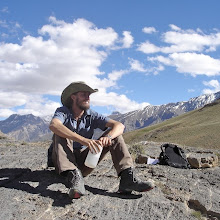
I think at this point some biography about myself, the photographer, is useful. Before I went to India, Spiti Valley was unknown to me. I went to India to study yoga with an Indian teacher, and then stuck around to travel— about nine months all together. Adventurous and idealistic, I began looking into volunteer work in the Himalaya, and came into contact with Spiti EcoSphere, an NGO who describes themselves as a “collaborative effort of the local community of Spiti and professionals from diverse backgrounds… We aim to create sustainable livelihoods that are linked to conservation” (spitiecosphere.com). So, with a very vague notion of where I was going and what I would be doing, I motorcycled my way north over the Rhotang Pass from Manali, and then east into Spiti Valley along India’s northeastern border with China. I spent the next month (and later another week) living with a local family, driving EcoSphere representatives to villages, organizing a first aide training for local guides, doing some English teaching, documenting wildflowers, and immersing myself in the local culture. Through the local connections I gained working at EcoSphere, I was offered numerous experiences I wouldn’t have been able to have as a tourist, and my work as a photographer benefited from these experiences enormously. Also, the extended length of time I remained in the area, as well as having my own motorcycle, afforded me the leisure and means to thoroughly explore the valley. Yet for all the richness of this experience, I know that I only scratched the surface in understanding what I think of as “the Spiti Situation”.
What follows is a series of photographs and writings that I am calling postcolonial photojournalism. I describe it as “postcolonial” because the issues in Spiti I hope to focus the reader’s attention on are well within the bounds of Moss’s definition of the term. Perhaps calling it photojournalism is a creative stretch, considering the liberal use of artistic license in the prose, yet I still feel the term is accurate in so much as this work intends to expose a current issue in the world today. I do not have high hopes for this project to change the world. In fact, I hope it keeps you out of Spiti Valley and inspires you to do absolutely nothing about the situation there, because probably the best thing any of us could do for Spiti is just that: nothing. It’s beautiful, take it from me; now don’t go there. Just look closely at each photograph, and be satisfied there is an essential truth in each one.
–––––––––––––––––––––

Kaza.
A dry stream divides it, Old Kaza and New Kaza.
Sometimes water flows in this creek, down the canyon, into the Spiti River, early in spring, when there is the most snow melt. It is dry more lately, there is less snow; the locals say.
See Old Kaza? On the left side of the stream. Brown roof tops, made from earth, cascade into a pattern of fields all the way to the steep bank and braided channels of the Spiti. Old Kaza.
To the right it’s New Kaza. Green metal roofs of government buildings; the hospital; an unused tennis court with no net because just who the hell plays tennis here anyway?; government school and private school; the military outpost; the police station; many concrete hotels: none of this was here before. Before… what? Do the local people call it progress?
That is not the word they use.
––––––––––––––––
 Drinking “arak” in Anjan’s house, and observing the observer.
It was my first trip to one of the small villages to stay with locals. I stayed with my coworker Anjan’s family at his small mud house. Anjan works with Ecosphere as a guide for tourists, and as such his English is OK. Like many, he understands better than he speaks. I felt very lucky to be welcomed into his family’s house, served food, tea, and a small glass of “arak” which is local alcohol distilled from rice. I knew, even as I sat in the room, bleary from altitude sickness (the village is at 4200 meters), that this would be a precious experience. I felt privileged to do participate in a night that was so normal for them and extraordinary for me. The dinner was not specially prepared, it was simple rice and dhal (not traditionally Spitian food, but now a common meal); nor were any great lengths to accommodate me made and I saw to it that none would be— otherwise Spitians are the most generous people and would have gone to nearly any length to see me comfortable. The conversation around me happened largely in the Spiti dialect but also in Hindi because there were two men from another region also staying with the family. They were two very young men who were helping Anjan with the labor to build his new house; they had the same appearance as the many road building laborers, and I knew Anjan couldn’t afford to pay them much besides food and shelter. The whole time I sat and listened, not understanding, to the quiet talking, laughter, socializing. Occasionally someone would direct a question to me through Anjan, and I would try to answer, but mostly I was just an observer in the room.
The TV volume was loud, and Bollywood music videos featuring tall buxom immodestly (by Indian standards) dressed women dancing with shirtless men reminded me of what I’d just read in Ancient Futures, “In films, the rich, the beautiful, and the brave lead lives filled with excitement and glamour. For the young Ladakhis, the picture they present is irresistible. By contrast, their own lives seem primitive, silly, and inefficient. The one dimensional view of modern life becomes a slap in the face” (Norbuerg Hodge, 97). Still, the TV is always on, playing loudly in the background; they would not think of turning it off. I stay one more night, and return with Anjan to Kaza.
This is a picture the modern Spiti house, and the changes its whitewashed mud walls are beginning to accommodate. For better or worse is not up for me to decide; time will tell for the local households like Anjan’s.
–––––––––––––––––

Traditional Spiti Socks: 200rs
I remember when Spiti Ama laughed
At the socks that I bought.
She would never pay good rupees
For socks like these—
She has made them for years,
So they must be worthless.
Always she wanted to know the cost.
How much this camera?
How much you pay to come here?
How much their thukpa?
I know this woman knows more about cost than it seems—
I do not think she is naïve—
She is at the change
When money is more valuable than value
I think she sees the loss
When a woman will sell her own socks
But no longer wear them.
––––––––––––––––––

She looked like an interesting subject— so tradtional. I wanted to show my Grandma a Spitian woman wearing a yak’s wool Kulu blanket like the one I bought her for Christmas. This woman was suitably old for my Grandma to relate to. So I turned my camera toward her, zoomed the lens to 400mm, and focused on her. I made the aperture as wide as possible to blur the background and establish the viewer’s focal point. I set an appropriate shutter speed to correctly expose the frame, and then I took several pictures so I could make sure I liked the expression she had on her face. I have saved this picture in several places: back up DVD’s, external hard drives, and here on my computer where I corrected the color so it would be like I remember it; where I subtly cropped an unwanted edge from the right; where I can publish this image to my website or print enlargements to frame and display in a gallery.
My artist’s statement is this: I hope to show my audiences something beautiful and real. This picture is a success to me. The detail of it satisfies me. It is crisp and clear, and the woman is alive, vivid. And this photo says more about a woman in Spiti than I alone could be capable. I wrote out everything above to say what I put into this image, to indict myself as a journalist of Orientalism, or worse, a tourist. But please, pull the photograph from my hands, and it is a truthful thing. It is a document of light and color, not of empty words; the words come after, light and color are first.
––––––––––––––––––––
 Road to Kaza from Key, 2008
The smell of burning tar reached the village miles away and a thousand feet above. It is dirty work building a road, and the crews rarely clean up what’s wasted. I see that the people working on building the roads are not from Spiti; locals tell me they are from Bihar, south of the Himalaya. They live in encampments near the road sites, crowded hovels littered with plastic trash. What does the government pay them? Less than the locals will accept for work like this.
The roads are helpful to the people here. They are able to get around better, to visit, to get supplies and health care in Kaza. Taxis shuttle folks about once or twice a day, filled beyond capacity with people and supplies. Many people, though, still use the footpaths that run more direct routes, but there is no debate that the people appreciate the roads.
Even so, sometimes roads around here just seem like a bad idea. These mountains do not take kindly to grading and paving, and they constantly bury the roads with rubble or give way beneath them. In the winter the roads are unusable, and then, as the snow melts, the thaw destroys much of the previous summer’s “improvements”. It seems like such arrogance to try to build roads in this terrain, a Sisyphean task that quite possibly invites more problems faster than solving old ones.
The roads bring the tourists to see everything they came to Spiti Valley to see. But the roads also bring in everything that the tourists don’t want to see. They drink bottled water and act disgusted when all the trash is burned on the side of the road. They demand flush toilets and wads of toilet paper where the water is scarce and sewage is overflowing. Roads are a contradiction here that bring more contradictions here.
 A man clears the road outside of Nako, 2008. The Valley is frequently cut off when roads become impassable from rockslides.
––––––––––––––––––
 At the entrance to villages there are always collections, usually hundreds, of these hand carved “mani stones”. Sometimes these cairns are more than a hundred feet long and about four feet high.
The subaltern do speak
And they write it on stone—
“Om mani padme hum.”
–––––––––––––––––
 Demul, June 2008.
This is a picture of a government school in Demul, a village of 55 houses. A sign at the base of the village (like many Spiti villages, Demul is situated on a steep hill) proclaims local sustainable tourist initiatives, like homestays, for “conservation of the natural and cultural heritage of the ecologically fragile Spiti Valley” and to make a little additional money to supplement the subsistence farming they do. Currency helps the people buy what, in their not too distant past, they would have had to trade for, and the people here are no doubt grateful for the convenience the diverse wares in Kaza’s bazaar now offer them. But did they bargain for the curse of poverty declared on their school building? Spiti, before, was mostly a closed system; there were only a few goods, salt, for instance, that they imported from outside their region, and while it was not a Communist society— some families did indeed have more than others— it was communistic in that the villages provided for itself the means needed to live. When the Spiti system became opened to new markets by roads, there was suddenly a whole range of outside cultures to compare themselves to; they could see Bollywood fiction on TV and seemingly rich foreign tourists.
The sign in Demul also declares the homogeneity of the village’s religious beliefs as the Sakyapa sect of Buddhisim, a religion that mostly renounces the accumulation of wealth. Reminded of this fact, the ideology printed on the government school seems more out of place, oppositional, or even insidious to the local culture. I see the school as a place of the ideological colonization fundamental societal beliefs. As the community’s children learn for the purpose of making money, why would they farm barley and peas? When their ambitions are to be doctors and engineers so they can buy motorcycles and diamonds, why should they look after a yak? And yet, if these children, and their parents too, want these opportunities, of course they should be available. Shaming one’s origins, however, seems imprudent and destructive, especially when these origins have so much to teach the world about sustainability and immateriality. It is not to preserve a culture for my own romantic notions of simplicity that I would erase those words from Demul’s school, but to stop the psychological feeling of inferiority they want to instigate.
–––––––––––––––––––
 Stuffed snow leopard hanging in the entrence to Sangla Monestery
Really?
This is what I want to preserve?
This is a culture of patriarchy that kills endangered snow leopards. The second born sons are sent packing to be celibate monks, no say for them; it’s tradition.
OK, because they build houses of mud and have a peaceful religion, because their villages are so picturesque and the little monks so adorable, because the people smile in their ignorance and are quaint in their rituals, I want to preserve this place so I can come to look, point and shoot, ooh and awe.
But really.
Some things around here could do with a little change.
Now, carefully, how will the Spitians change? A new world and new ways have shown up in their valley. I hope they can pick and chose, with awareness of the consequences, the changes they will make from within. But what I see happening is the domination of their small fragile culture by a large powerful assimilating one.
It’s not that this is a place that shouldn’t change. It’s not even that this is a place that’s incapable of changing itself. It’s just not right for that change to come from outside.
–––––––––––––––––
 Locals outside of Demul, 2008
They are excited for me to take their picture. As soon as I make several “clicks” they are reaching for my camera, laughing at their images, saying what— I don’t know— about themselves.
They leave their knitting
to ride my motorcycle
I am so ashamed.
––––––––––––––––––

I wondered what Mr. Bhabha would make of this sign. It stands outside the medium sized village Chicham. It seems this is one of “the complex strategies of cultural identification and discursive address that function in the name of ‘the people’ or ‘the nation’ and make that the immanent subjects and objects of a range of social and literary narratives” (Bhabha, 292). These people are making a very real attempt by declaring the protection of special plants to locate, in the present, what Bhabha would term a metaphor of community. But then these people have never heard of postcolonialism or deconstruction.
What else does this sign say? It begs the question, who must these plants protected from? The repetition of the word “local” on the sign implies the plants are protected from non-locals, probably mostly tourists. Chicham, as a village, seemed to me the most— dare I even say— hostile of communities to outsiders. It is, for one, one of the hardest to get to: either by way of a very long drive or a difficult hike through a deep canyon, and therefore it sees relatively few tourists compared to its neighbors. The feeling as I walked through its streets and pathways, alone, was of skepticism, even avoidance, of me. No one talked to me or invited me in for tea, and that was unusual. The feeling in this village, on this sign, is indicative of the presence of an invader, a colonizer, and what’s more is that I, in feeling that Otherness (to think of Said), was indicted as the colonizer. I had wonderful intentions there, photographing and cataloguing the rare medicinal plants in the area, but this sign confronted me as an agent of modernity. Who was I photographing these plants for?
Whether or not the conflict of the “virtuous colonizer” has a satisfactory resolution depends on who you talk to. The people I worked with at Spiti Ecosphere surely felt that yes, we could be of help alongside the locals. However, I talked to a few locals who did not feel that way.
–––––––––––––––––––––––
 The rugged Himalaya cut Spiti Valley off from the rest of India, 2008.
Let the land speak
About a liminal space
With a saw tooth edge.
Look how the layers talk about process
By folding before you
What geologists call a “fault”.
An idea is thrust
This barrier between
Flesh—
That’s the Himalaya;
Living mountains
Upon the between.
I talk to you Mr. Bhabha
For spelling out
What the mountains already said.
–––––––––––––––––––
 Old and New monasteries side by side in Sangla, 2008.
I guess a thousand year old temple can’t stand forever. I guess they will have to replace it, eventually. But the one at right was built from the land and has accumulated the sacredness of generations. How can it be replaced by one built of concrete and money? It seems truly a sad irony that the rupees coming in from tourism, a tourism based on seeing thousand year old monasteries, are being used to construct concrete replacements of their ancient counterparts. But maybe, when the old ones crumble and the concrete ones are finished, tourists won’t come to gawk any more, and life will get back to normal around here.
I, the photographer, do not know what this picture says. Perhaps it says to me, it is too late for Spiti; they have abandoned their essential traditions. The temple was an icon of something essential to their culture, and seeing the soulless modern version shows the irrevocable loss. Or perhaps it says to me, I don’t know what is essential to Spiti, and there is really nothing incongruous about these two temples; quite possibly, to a Spitian, these temples are fundamentally the same, not fundamentally different. It seems the meaning of this photo depends on who you ask.
––––––––––––––––––

 A small fossil I found outside Langza and a local man with the biggest “chadua” he’s found, 2008.
The ammonites
Here
Are part of
The landscape
These fossils are
Historical
My uncle is a geologist—
I think about
Paleontology—
I have the spiral stone in my
Pocket
I think it will make a great
Paperweight—
It seems like there are plenty
And the travelers who come here
Hiking to the creek bed
Are few
So
I take.
But the ammonites
Are not paleontology
The fossils
Were not fossils
Before—.
Before they were “chadua”
Which means “bird stone”
Which makes me think
It is not my history
To take home
With a different name.
–––––––––––––––––––––

 The classic Spiti dry toilet is the top picture. Below is the modern flush version, the typical Indian squat toilet. Neither of these toilets is sustainable with the population growing at its current rate.
––––––––––––––––––––
 Self portrait at Chandra Tal, 2008
This is how I would like to finish, to “conclude”, my exploration of the “Spiti Situation”. Forget the theories. Forget the discourse. And please forget my vain self-indulgent writing— it’s all empty, a shadow, and we each create our own. But please please please remember the photographs; remember what you’ve seen, because that part is real. Tread lightly.
–––––END–––––
Works Cited
Bhabha, Homi K. “DissemiNation: time, narrative, and the margins of the modern nation.” Ed. Bhabha, Homi K. Nation and Narration. London & New York: Routledge, 1990. Print.
“Ecosphere Spiti Eco-Livelihoods.” www.spitiecosphere.com/about_us.htm. n.p., n.d. Web.
Hight, Eleanor M and Sampson, Gary D. “Introduction: Photography, ‘Race’, and Post-colonial Theory.” Colonialsit Photography: Imag(in)ing race and place. Eds. Hight, Eleanor M. and Sampson, Gary D. New York, NY: Routledge, 2002. Print.
Moss, Laura. “Is Canada Postcolonial? Introducing the Question.” Is Canada Postcolonial: Unsettling Canadian Literature. Ed. Moss, Laura. Waterloo, Ontario: Wilfrid Laurier, 2003. Print.
Norburg-Hodge, Helena. Ancient Futures: Learning From Ladakh. Berkely: Sierra Club Books, 1991. Print.