08 July 2008

I'm smiling =)

So, having the feeling that my luck in India was running thin, I've taken a little trip to Thailand. I only planned to stay here a little more than a week, but I'm so taken with the country that I've pushed my return ticket back till July 31st-- the farthest date possible with my ticket.
I'm going to skip the harrowing story about getting out of India -- ask me sometime -- and just keep this blog to Thailand. Needless to say, India had one more stretch of madness for me before I could leave (road crews, dynamite, landslides OH MY!). Let's keep to the present; we're in Thailand now.
Part of why I decided to come to Thailand was because my friend Elle, from the yoga teacher training in Mysore, lives in Bangkok. She volunteered to be my tour guide, so for the last week I've had her and her Japanese boyfriend Kei to take me all over Bangkok. They've been exceptional hosts; I have to fight to pay for anything, they gave me my own room, have high speed internet, and are good company wherever we go.
Let me assure you I knew nothing about Thailand before coming here. I bought a Lonely Planet the day before my flight, and, like I said, only planned on staying about a week. I just wanted to get out of India, relax, and renew my tourist visa. Niavity!! This is a wonderful country, and Bangkok is a wonderful city. It's clean, cars drive in lanes, people put litter in waste baskets, unobnoxious beggars, shorts, air conditioning, and amazing food. I had grown so used to the chaos of India and didn't expect to find anything different here, but Thailand is different.
I have adopted a relaxed pace around here and don't do too much site-seeing each day. There are more interesting things to do than go to the tourist spots, like just hanging out with Elle's friends. I have done a few tourist activities too though, like visiting Jim Thompson's house, The Tiger Temple, Khao San Road, Chatuchak Market, and Lumphini Park. Otherwise I've spent my time going to yoga class in the mornings and then taking the sky train here or there, to that mall or this mall. I'll let the photos below tell the story. So far, no, I haven't done what Bangkok is known for, and if you don't know what "that" is, then I won't mention it.
Soon I will head out to Krabi Province south of here to try to do some rock climbing on the famously juggalicious coastal limestone formations, or do some scuba diving at the world famous reefs, or just hang out in a room reading when it's monsooning too much to play outside.
Life is good, perhaps too good, because I feel a little guilty having it so nice. Do I deserve this? Really, it's probably better for me not to ask that question (or to consider my credit card tab). Better just to acknowledge my good fortune and be grateful, which I certainly am.
Oh yeah, and with reluctance I put myself on FaceBook. Actually, it wasn't a bad move. If you're on it, look for me there. And while FaceBook is certainly more user friendly, and more addictive, I am going to try to keep this blog the priority because it's less kitsch more informative. And on that note, on to the pictures:


My hosts Elle and Kei outside one of the many malls in Bangkok. We were checking out a free photography exibit called Earth from Above. They were some breathtaking images from around the globe, all arial shots. Unfortunately I don't have a hot air balloon in my back pocket.
Those of you that know her might notice that Elle is pregnant, but you'll have to get the story from her.


To confuse matters, this is Little Elle, Elle's best friend Elle... yup. Anyways, one night we all went to Khao San Road for dinner. There are many cool T-shirts (and plenty else) for sale at bargain prices, so I snagged a couple I liked. Elle here is buying some sliced fruit with the famous backpacker street's bright lights glowing behind her.


This may not look like much to you, just an average city scene, but to me it's glorious. Clean and orderly, this city is NOTHING like India's debacles. Also to note is the Sky Train gliding through on its way from some of the many massive malls. Maybe you know I am a huge fan of city mass transit systems-- the New York Subway, San Fran's BART, Portland's MAX-- and the Sky Train ranks up there for ease and convinience.


Meet Kai Chiow (translation: "Omelet"), Elle and Kei's young Shar-Pei mix. He is not friendly with me, but I'm making progress: he hasn't tried to bite me in four days. And that's Elle's boyfriend Kei ("Kay") holding him.


Orchids are the national flower of Thailand, and they're growing everywhere around Bangkok, but I still can't get used to seeing them. To me there still rare, exotic, expensive flowers and there's nothing common place about them, so again and again Elle smiles patiently while I say "Wow! Orchids!" Here's masses of them bundled up and for sale for 20 baht, or about 75 cents, in all their orchidly glory.


And lotus blossoms are for sale at a similar price; these are traditional gifts for Thailand's many buddhist monks.


You can buy almost anything at the Chatuchak market; it's huge! There's a huge art section with amazing paintings for sale-- cheap. The pictures of the previous flowers were taken here also, and there were many more, rarer, varieties of orchids on sale. Elle had been telling me about the pet section, so we went to have a look at some puppies.


Maybe soon Kai Chiow will have a friend...


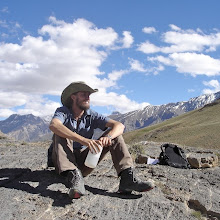
I shaved my beard. It was time-- new country, new look.


Another stop on the tourist circuit is Jim Thompson's House. Jim Thompson is the original ex-patriot American in Thailand who set up a major silk trading house and revived the silk industry here. He brought together six traditional Thai houses and filled it with ancient art-- he was partial to Buddha statues and there's one here from the 7th century. The gardens are nice too, and that's all I could shoot because photos were not allowed inside. Bummer.


The three of us made a day trip out to Kanchanaburi on the way to the Tiger Temple. Hanging out by the somewhat famous, heavily touristed, and dramatically named Death Railway Bridge I was struck by how big the motors in these boats are. With a big block V-8 in a canoe, they're ready to zip tourists off to... some other tourist place I don't know where.


The elephant's trunk is an unpredictable thing.


So here's the deal with the Death Railway: the train comes roaring so fast over this bridge and tourists are so awe struck, trying to take pictures, that they are squashed by the speeding locomotive. No, just kidding. The train actually moves very slow over the bridge so the woman here is in no danger. The railway gets it's name because in WWII the Japanese occupied Thailand and used forced labor to make the Thai people construct it. Many died.


I'm like a little kid around trains, so the camera went click click click.


Now that I have your attention, welcome to the Tiger Temple. Lonely Planet calls it "a petting zoo for big boys", well, that doesn't quite sum it up.


Elle and Kei posing with an adolescent tiger. Yes they're quite safe, these tigers were raised by monks and are haven't eaten manflesh yet.


Check out this kitten, the size of the biggest full grown house cat. The tigers at the Tiger Temple are orphaned, their parents poached, or bred in captivity. So this little guy will be raised by the monks and other volunteers and temple staff to be docile, socialized creatures... with razor sharp claws and fangs.


But alongside the altruistic intentions of the Tiger Temple, it seems like someone got greedy. Currently the sizable amount of tourist money isn't going into wildlife funds, habitat preservation, education initiatives, or anti-poaching legislation; instead the thousands of baht are being used to build elaborate false waterfalls, performance arenas, and other highly artificial, spectator friendly enclosures to ensure the Tiger Temple continues to climb higher on Thailand's "must see" list.


Despite my mixed feelings, I was really happy to get so personal with tigers. Although you could get really close to the tigers, these shots were made with my sweet new 400mm telephoto (available on the cheep in Bangkok).


Tickling a tiger.


Maybe the biggest tiger, the purple on his back leg is antibiotic. If he looks drugged to you, remember that tigers are nocturnal prefer to sleep all day. That helps to explain their calm, not to mention growing up with Buddhist monks-- some of the calmest people on earth.


And here I am hugging a tiger. Good kitty, I wuv you. Despite being tame, the tigers still have quite a presence. Touching them you can feel the tigers' power, their amazing strength, their feline prowess. This is an endangered species folks; their habitat is quickly deminishing; and people, us, are responsible. But let me end with optimism: our actions in this life are not ineffectual. Little steps do make a difference. Positive change, no matter how small, is positive change.
And if you don't try, I'm going to sick this tiger on you.

Much love everybody. Till next time,
Ethan

24 June 2008

Hiatus

Julley Everyone
I say "julley" because that is the local greeting here (say "joo lay"), and I have grown rather fond of using it. Responses are almost always friendly- a reflection on the local culture.
But no one has told me the Spitian word for goodbye, and I'm not actually sure there is a concise way to say it, but goodbye is what I will be saying to Spiti for the next few weeks. Yep, I'm on my way out of the valley, heading south down to Shimla where I'll ride the Indian rails to Delhi to hop a plain to Bangkok, Thailand. What? Bangkok? Yes, I have to take a break from India-- two reasons. One, if I don't leave the country in July to renew my tourist visa, I will be deported. And two, I think I need a short break from India. I've had a few illnesses here in Kaza (it's a daily germ bombardment) that have left me tired, and as well I think some space from India will give me some renewed perspective I can use creatively. So Thailand it is! I have a friend from my Yoga TTC from Bangkok, and she has volonteered to be my Thai ambassador and tour guide. Should be sweet-- a small trip inside a big trip, like Shakespeare's play within the play.
Anyways, last couple weeks in Spiti have been fantastic. I've spent a good portion of time with a couple Spiti teenagers who, after several years working with our American teenagers, are a real pleasure. While they go to the private school in Kaza, I've gone to their homes in the villages and they are serving me chai and showing me their fields and telling me about their yak. They don't do anything deviant as far as I can tell. They are very shy around girls-- when I was at one's house and about six young women came in, he hid in another room -- "I am very shy" he said.
Anyways, I will let the pictures speak and tell their story. Sorry the resolution of these pictures and the last batch is lower than the quality was before, but as I've said internet here is unreliable and slow, so it's the best I can do.
Hope everyone's stepping into a nice summer; I've heard from many of you about your summer plans and I think we can all be mutually envious.
All the best and much love,
Ethan


Road building presents the Spiti quandry succinctly: what cost for modernization? While roads offer an undeniable improvement to the quality of life here, the cost is pollution (pictured) and a massive influx of cheap laborers- tripling the area's population-- and leading to a host of new problems.


Part of the work I'm doing with ecosphere is cataloguing wildflowers and writing a document on what's growing where, local names, and local uses. This is one of my favorite wildflowers blooming now at the higher elevations, above 13,000 feet. It's called Arnebia euchoroma, and I love how it blooms black flowers, pink flowers, and white flowers all in a cluster. Local use this plant medicinally as well as for making hair oil and red dye. Really cool.


Just as I was getting bored of wildflowers, thinking I'd seen all that the season had to offer, I stumbled upon a wet environment in the untouched village of Dumle and a field of, I couldn't believe it, orchids. Dactylorhiza hatagirea, or "aung po lackpa" in Spitian, is another important plant to Spiti and the root is used medicinally by the "amchi", or local doctor. Not to mention it's BEAUTIFUL.


A scene from the streets of Kaza, a young boy in orange mightily pumping water.


In the house of Kunga, one of my teenage friends, I had a lot of fun with the women preparing "timoh", a local steamed bread. Here the little doughballs sit on the woodstove steaming their way to gooey yumminess.


This beautiful Spiti woman is Kunga's sister. Sometimes the young Spiti women are very shy, but always from that shyness the most beautiful smiles come. And sometimes they are not so shy: once, around a large group of locals, one young woman asked for a short ride on my motorcycle. Never one to turn down a chance to have a pretty woman along for a ride, I agreed, and next thing I know not one but THREE women are getting on the back of my motorcycle... so off the four of us go, the three of them laughing and talking excitedly, and me just hoping I can manage my bike with four people on bored. This story repeated itself ten minutes later... Long story short, I find these women some of the most beautiful on the planet.


Women aren't the only ones in India carrying things on their heads. Also to notice in this picture is the ditch of flowing water the man's walking alongside. It's an irrigation channel running through Kaza down to the fields below, and also serves as a place laundry's done.


The village of Kibber on a sunny day.


Hiking through a canyon from Kibber to Chichim, I came accross some curious stone and mud buildings with these queer contraptions inside. Upon inquiry I found these are mills used for grinding barley. Barley goes in the big funnel and is slowly let through, and water comes through to turn the big stone.


A local shaggy haired donkey guarding the door in Chichim village. Have I arlready posted a donkey picture? These are damn fine donkeys!


My 17 year old friend Kunga showing me the local rhubarb, "litchu", that grows at high altitude (over 14000 feet).


Next he went about showing me how to prepare to eat it by peeling the outside off to get to the tender inside.


It's sour, sweet, and crunchy. Yum!


An amazing sunset as seen from the village of Komik, my friends home village. Komik is the highest village at 4,500 meters with great views all around.


This is your classic Spitian dry toilet. Aim carefully please.


This is from the ridgeline above Komik. I don't know the altitude, but I can tell you after a night of sleeping well higher than my level of acclimitazation, hiking up here neerly finished me. If I want to hike Khan Mo, an approachable, non-technical 5,950 meter peak (you need a permit to climb a peak higher than 6000), I will really need to condition. Altitude, as it turns out, is no joke.

I admit this post has been a bit rushed and may be slightly substandard. Please forgive me! Next post: Thailand!

12 June 2008

Another day at the office...

Hello Everyone,
This is Kaza, my home, from a road high above.

On the left side of the dry creek is Old Kaza, and flowing out like branches from the city are green fields-- the traditional setup of a Spitian village. To the right is New Kaza, where you will see no fields flowing from below but perhaps you will notice a new sort of field-- feilds of concrete. New Kaza is home to the many government buildings installed here, government schools, government hospitals, government administation offices... on New Kaza side you will even find, un-netted and unused, the concrete rectangle of tennis courts. And at the top of the picture witness the drama of the Spiti river and the Himalaya Mountains. This, friends, is the beautiful and complicated scene of my life.
Perhaps you'll remember I'm working at an NGO here named Spiti Ecosphere, and my job brings me to the fringes of the Spiti Valley and into close contact with the regional culture. Most recently I taught a first aide class to about 20 villagers, and despite the language barrier (everything I said in English had to be translated into Hindi, which, taught in the government schools, is not the primary language of the locals) was, I think, rather successful. Other projects have been to fix up the bikes we let, help teach some English classes, and write up some reports, but my must usual and relished job is the documentation of nature and culture in the area, or, in another word, photography.
So here are some snapshots derived from this great Spiti project for your enjoyment and education.


The Pin Valley is an offshoot of the Spiti Valley, and up this beautiful gorge lie several villages connected by a single road. Pictured here is the Kurgi Monestary which has with three temples: one 800 years old, one 400 years old, and the third completed several years ago.


Everyone loves a good rainbow picture: a lucky day in the Pin Valley.


Many wildfowers are beginning to bloom, especially at the lower elevations.


A small building signaling the proximity of Damul, and the ubiquitous prayer flags of Tibetan Buddhism. A note on prayer flags: once put up they are never taken down, and are allowed to disentegrate over time, so you see them in various states of their existance: from bright and colorful to pale and threadbare.


Young girls outside the government school at Damul. You'll have mixed feelings about the coming of government schools to the Spiti. While there can be little doubt of the importance of education anywhere, especially of literacy, government schools here do not teach in the local language or in ways particularly relevant to the area, so the local culture is gradually phased out. Imagine your conflict if in gradeschool you were taught in Chinese, and all the examples came from a Chinese context; would you feel unsure of your identity?


Despite its remoteness (the road to Damul was only built 3 years ago, and is still quite rough), Damul is a one of the largest villages I've been to. I came to Damul with Sonam to find out how the women here have been doing producing local knit-wear. The sale of local handicrafts is an initiative designed by Ecosphere to empower the women of the area giving them a way to bring in Rupees while simultaneously preserving part of their culture.


This is a basket of dung. In the traditional Spiti culture, nothing is wasted, not even manure. It is collected and used for feul. Also, I am falling in love with these baskets, the Spitian version of a backpack. Hardly looks comfortable, but the simple utilitarianness of it appeals to me.


Looking South East down the Spiti valley from a little old 15,000 ft peek where you are supposed to be able to see 14 villages. I counted 12, but I doubt my eyes are as sharp as the locals'.


The braided channels of the Spiti River in the glare of sunset.


Wildflowers aren't just blooming at the lower elevations; this little yellow flower in the pea family is blooming now at over 5000 meters.


I've decided part of my Ecosphere work should involve peak bagging, so I tagged this unnamed mountain right above Rangrik (just outside of Kaza). A lesson in hiking Himalayan mountains: they are always, ALWAYS, much bigger in reality than they appear, and despite this mountains unassuming appearance from the ground, it was a beast. The air is just a lot thinner at 16,000 feet.


It should go without saying that the view from the top was outstanding. "Outstanding" is such a banal way to describe looking accross the Himalayas, but I'm trying not to use obscenities here. Just look at those f*ing things! (sorry!)


Looking down from the top of my Unnamed Mountain, the Key Monestary looks very small. You can still see the way monestary is stuck right on steep hillside high above the village of the same name. This is a splendid place.

Thanks to everybody who has written to let me know how they are doing. As some of you know, I've decided to stay in India until November. While this decision brings me a lot of joy because now I will have time to chase down a few more Indian dreams, there is also the heavy weight of time and homesickness. I miss home! But hearing from my friends and family gives me a lot of joy and helps me stay focused here.
I wish everyone the best, and send much love.
Ethan